

Enhancing positive impacts
on our land
What it’s about
All our owned plantations — an area covering approximately 390,000 hectares – are 100% FSCTM certified which means they are managed and audited according to certain principles and criteria. Responsible forest management is also about taking small steps, all the time, that enhance positive impacts on our land. Here are a few examples:

Using the electro shocker to stun fish for identification
Protecting cycads
South Africa is an important hotspot for cycad diversity. Yet they are the most threatened plant group in South Africa, and one of the most threatened group of plants globally. Almost 70% of our cycad species are threatened with extinction, with four on the brink of extinction and seven which have fewer than 100 plants left in the wild. Illegal harvesting for landscaping purposes and also for the acquisition of particular species for private collections are the main threat to South Africa’s cycads. These illegal activities have devastated wild cycad populations.
Accordingly, when a cycad was noted in the grounds of an abandoned homestead on one of Sappi’s plantations, a site visit was arranged with members of the Lowveld Botanic Garden to dig up the cycad and relocate it to the cycad gene bank at the Lowveld Botanic Garden. The Sappi cycad has been catalogued for future curation by the Botanic Garden.
Monitoring water quality and fish stocks
We use the aquatic biomonitoring SASS (stream assessment scoring system) methodology to determine the quality of water in rivers on our landholdings, as well as river health. Accompanying the SASS water quality monitoring in 2019, we undertook fish surveys of rivers in both KwaZulu-Natal and Mpumalanga. Understanding what fish species occur within our smaller river systems helps us understand the importance value of aquatic ecosystems and where possible to implement corrective actions to reduce our impact on the natural environment.
The importance of this was highlighted by the Minister of Environment, Forestry and Fisheries, Barbara Creecy, when she recently launched the country’s third National Biodiversity Assessment report: “The most concerning of the report’s finndings relate to our freshwater ecosystems, rivers, wetlands, estuaries, and freshwater fish stocks. These are the most vulnerable of all species groups and the most threatened ecosystems in South Africa.”
We continue to involve local schools in mini SASS monitoring programmes.
Greening the escarpment
Following the success of the ‘Turning Kruger Green’ project which Sappi sponsored to its closure in 2016, Sappi Forests was approached by representatives of Birdlife Lowveld for financial assistance towards the ‘Turning Escarpment Green Project’. The objective of the project is to provide data for the national Second Southern African Bird Atlas Project (SABAP2). The project aims to map the distribution and relative abundance of birds in Southern Africa and includes: South Africa, Lesotho, Botswana, Namibia, Mozambique, eSwatini, Zimbabwe, and Zambia.
To gather data, volunteers select a geographical ‘pentad’ on a map and record all the bird species seen within a set time frame. This information is uploaded to the SABAP2 database and is used for research and analysis by several different agencies, including the South African National Biodiversity Institute, BirdLife South Africa, as well as academics and students at various universities.
As of July 2019, SABAP2 volunteers had collected more than 17 million records across all protocols.
This valuable dataset is key to determining the conservation status of bird species, correctly assigning red-list status and establishing Important Bird and Biodiversity Areas, as well as forming the basis for informing environmental impact assessments. To gather valuable and useful data, atlas coverage needs to be as thorough as possible. Ideally, each pentad should have a baseline of at least four comprehensive checklists (‘cards’), over several years and seasons. On the coverage maps this will mean a pentad turns ‘green’1.
Sappi identified several benefits in being involved in a project of this nature. We have several plantations located within the study area, and by mapping the bird diversity along the escarpment and relating to bird population change indicators, valuable information on biodiversity trends would be obtained. Also, the collection of up-to-date reliable bird sightings provides an opportunity to compare bird populations listed from Sappi properties and those outside the planted landscape, on other land uses.
The escarpment atlas project began in July 2016 with a total of 111 groups of five cells (pentads) falling within Sappi forestry estates. Of this number, 70 were existing ‘green’ pentads. By May 2019, 99 of the 11 pentads had been turned ‘green’ and 12 pentads need 16 cards to be completed, to turn all plantations green.
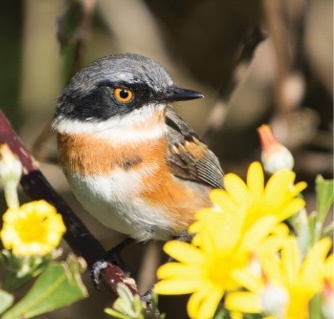
The Cape Batis was one of the species commonly reported in the grassland pentad

The Spotted Eagle Owl is a common bird in the plantation landscape