


Making an impact
by driving shared value
What it's about
Sappi Khulisa growers needed an income while they waited for their trees to reach maturity – by not harvesting at four years and waiting until seven years to harvest, smallscale growers can increase their profitability by 40%1. The African Honey Bee (AHB) initiative is a social enterprise project situated along the coast in KwaZulu-Natal (KZN), from Richards Bay to the Mozambican border, that meets the need for interim income while expanding avenues of income and entrepreneurship.
Sappi's involvement in the project is twofold: we make certain plantations available for beekeeping and we sponsor training and equipment. The latter involves instruction in honey collection and beekeeping, as well as teaching participants how to catch wild swarms.
In 2017, African Honey Bee started teaching the beekeeper families to form groups at venues like churches or community halls, within walking distance from where they live. So far 60 groups have saved money that they then loaned to members to start beekeeping, chicken and vegetable incomegenerating activities. The loans were all paid back with interest, and the savings and interest were paid out after saving for a year. In conjunction with the savings, income-generating principles and ‘businesses in a box’ were taught to members.
Key developments
In 2017, 2018 and 2019, AHB trained 1,734 families in KZN. Assuming a family size of five, this means 8,670 people were indirectly impacted by the training. A total of 862 of these families are beekeeping from one or more hives. Others are still hunting honey, but in ways that are more sustainable and do not cause uncontrolled fires.
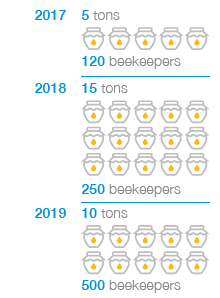
In 2017, African Honey Bee purchased five tons of honey from 120 beekeepers; in 2018, 15 tons from 250 beekeepers, and in 2019, 10 tons from 500 beekeepers.
The beekeeper families earn ZAR50 per kg when they supply the honey. From the honey sold in 2019, they will also earn a share of the value chain profits which will be an additional ZAR7 per kg. The honey, once harvested by the local communities, is packaged and sold throughout South Africa in a fair trade agreement through www.peels.co.za as Sizana traceable honey.
Shared value impact
- Employment and skills development
- Reduced environmental impact.