
REMUNERATION
REPORT
This Remuneration Report details the company's compensation policy for executive directors, executive committee members and non-executive directors.
The information provided in the report has been approved by the board as per recommendation by the Human Resources and Compensation Committee.
The report is split into three sections: section A details our remuneration background statement disclosures, section B gives an overview of our remuneration policy and section C addresses implementation of the remuneration policy in 2019.
Section A: Remuneration background statement disclosures
I am pleased to present the committee's report on remuneration. Our report and disclosures fully comply with regulatory and statutory provisions relating to remuneration governance in all the countries in which we operate. This report is aligned to the principles and recommended practices of the King IV Report on Corporate Governance of South Africa (King IV) and as part of our commitment to good corporate governance.
Sappi Limited's AGM was held on 06 February 2019 and ordinary resolutions endorsing the remuneration policy and implementation reports were passed with 95.94% and 93.43% majorities, respectively. This vote by our shareholders is an endorsement of Sappi's good governance and disclosure.
Following positive feedback and support from our shareholders, we have further improved the following in the 2019 report:
- Disclosed reasons why Performance Share Plan (PSP) allocations were being adjusted up or down
- Disclosed executive directors' key objectives
- Included working capital in the calculation of the cash flow return on net assets (CFRONA)
- Adjusted limits of the PSP in line with shareholder recommendation of 5% of issued share capital See resolutions in our Notice to shareholders.
- Disclosed that the terms and conditions of the annual incentive scheme for executive directors and executive committee members also affords the company the right to seek redress and recoup from an individual where for any reason the board determines within a 12-month period of such payment.
We value the input of our shareholders and will continue to seek their input to ensure good disclosure.
As detailed in the Chairman and CEO's report, in the year ended September 2019 a number of major factors influenced the group's results, namely:
- Prolonged weakness in global graphic paper markets was experienced
- In the second half of the year, the graphic paper segment started to benefit from a reduction in input costs, particularly paper pulp, helping to mitigate the impact of lower volumes
- The year started strongly for dissolving wood pulp (DWP) markets, with pricing above long-term averages for the first six months. Thereafter, the combination of the impact from global trade wars on Chinese textile markets, excess viscose staple fibre (VSF) capacity and a weaker Renminbi exchange rate drove DWP prices to historical lows, impacting profitability in this segment
- To mitigate the impact from lower profitability, capital expenditure was postponed and reduced. Tighter working capital measures were also implemented.
During the year, Sappi made further strides towards diversifying its product portfolio into higher-margin growth segments. This involved plant conversions to increase our packaging capacity in Sappi North America (SNA) and Sappi Europe (SEU), and in Sappi Southern Africa (SSA) to debottleneck and to improve our DWP plants, for both capacity and sustainability footprint. These projects removed production capacity from our operations during the conversion and subsequent ramp-up periods which had an impact on short-term EBITDA. In the year ahead we will continue the project to boost DWP capacity by 110,000 tons at Saiccor Mill in South Africa. Following the recent conversions at Somerset, Maastricht and Lanaken, the product portfolio will be further optimised with a significant increase in packaging volumes.
The remuneration policy and its implementation aims where possible to balance short-term market conditions with the need to incentivise management to continue to drive performance and implement the long-term strategy.
Two resolutions will be put forward to shareholders at the AGM in February 2020 to reset the number of shares under the plan (Performance Share Plan). Our existing number of shares under the plan and the scheme have been in place for 14 years and the board was prudent in the allocation of the shares over this time. This allowed for an effective annual burn rate of just under 1%. However, these shares are almost fully utilised. During the year we engaged with and received the input from large shareholders before finalising the resolutions.
For 2020, the focus for Mr Binnie and his leadership team will be as follows:
- Drive the Safety-first programme
- Continue leading the Sappi Values (of integrity, speed, courage and Smart decision making)
- Lead the roll out of the Sappi 2025 strategy
- Execute Saiccor expansion projects as planned and guide the DWP business through challenging times
- Grow the packaging and speciality business with optimal volumes
- Manage the graphics business capacity
- Drive operational excellence across all plants
- Integrate Matane Mill into the Sappi environment
- Drive One Sappi initiatives across all regions
- Ongoing training and development of people
- Drive Sappi's sustainability footprint
- Work to ensure the short-term incentive plan is mindful of challenging trading conditions and to gain optimum performance in FY20 results
- Show significant progress on commercialisation of new biotech products
- Talent management and succession – managing key retirements over the next 12 months and near-term succession.
Our remuneration policy is continuously benchmarked against relevant industry peers to ensure it motivates our senior team to achieve the group's objectives and deliver sustained returns and value creation for our stakeholders. The committee also believes that the remuneration of executives in 2019 reflects our challenges and successes to date in the delivery of our strategy. Thank you for the support and advice that you have given for our 2019 Remuneration Report. The improved disclosures on our policy and the implementation report reflect this feedback. I look forward to continuing engaging with you in future.
Mike Fallon
Chairman of the Human Resources and Compensation Committee
Statement of voting at AGM
The AGM of Sappi Limited was held on 06 February 2019 and the requisite resolutions endorsing the remuneration policy and implementation report were passed as follows:
Ordinary resolution number 7: Non-binding endorsement of remuneration policy
| For | Against | Shares voted | Abstain | |
| 401,173,338 | 16,971,270 | 418,144,608 | 287,954 (0.05%) |
|
| 95.94% | 4.06% | 74.75% (voteable shares) |
Ordinary resolution number 8: Non-binding endorsement of implementation report
| For | Against | Shares voted | Abstain | |
| 388,806,540 | 27,338,144 | 416,144,684 | 287,878 (0.05%) |
|
| 93.43% | 6.57% | 74.39% (voteable shares) |
At the February 2018 AGM, results for the requisite ordinary resolutions endorsing the remuneration policy and implementation report were 99.43% and 92.14% respectively.
Human Resources and Compensation Committee
The purpose of the committee is to oversee remuneration matters for all controlled subsidiaries of Sappi Limited. Its key objectives include:
- Make recommendations on remuneration policies and practices, including Sappi's employee share schemes
- Ensure effective executive succession planning
- Review compliance with all statutory and best practice requirements on labour and industrial relations management.
At the end of the year, the committee consisted of five independent non-executive directors:
- Mr MA Fallon – Chairman
- Mr B Beamish
- Mr NP Mageza
- Mr JD McKenzie
- Mr RJ Renders
The Chairman of the company, Sir Nigel Rudd, attends committee meetings ex officio while the Group CEO, Mr SR Binnie and Group Head Human Resources, Mr Fergus Marupen attend meetings by invitation. Mr JD McKenzie retires at the end of December 2019.
Mrs A Mahendranath, Company Secretary, attends the meeting as secretary to the committee.
The Human Resources and Compensation Committee met four times during the year and held one telephone conference.
Attendance at meetings by individual members is detailed herein.
None of the committee members has any significant personal financial interest, or conflict of interest, or any form of cross directorship, or day-to-day involvement in running the business.
Executive directors and managers are not present during committee discussions relating to their own compensation.
The committee ensures that compensation practices and structures in the group support its strategy and performance goals. The policy also enables the attraction, retention and motivation of executives and all employees.
Key activities of the committee in 2019 are summarised as follows:
- Reviewed and approved the vesting, or otherwise, of performance share plan awards awarded on 04 December 2015
- Approved winding up of the Sefate employee empowerment scheme for South Africa
- Approved allocation of 2019 performance share awards to executive directors and all other eligible participants
- Reviewed and approved salary increases and bonus payments for executive directors and other key senior managers for 2020
- Recommended fee levels for non-executive directors of Sappi Limited for consideration and recommendation to shareholders for approval
- Approved the allocation model and comparator peer group for the 2019 performance share plan
- Reviewed the Remuneration Report, including the content of the company compensation policy and practices, which was put to shareholders for a non-binding vote at the AGM in February 2019
- Approved the 2020 Management Incentive Scheme rules and reviewed the Share Incentive Plan rules, including changes to the Performance Share Plan
- Reviewed the share limits of the PSP and recommended two resolutions to the AGM
- Reviewed succession, retirement and development plans for key management positions
- Reviewed the group's Industrial Relations Policy and implementation
- Reviewed the group's training and development policy and implementation
- Sought advice on the implementation of a return measure, ROCE, as part of future incentive plans.
Independent advice
Management engaged the services from the following organisations to assist in compensation work during the year:
- Mercer Kepler, United Kingdom
- Korn Ferry, South Africa
- KPMG Inc, South Africa
- Bowmans, South Africa
- PricewaterhouseCoopers Tax Services, South Africa.
Compliance statement
The Human Resources and Compensation Committee is committed to maintaining high standards of corporate governance and supports and applies the principles of good governance advocated by King IV. Our remuneration approach and disclosures fully comply with regulatory and statutory provisions relating to reward governance in all the countries in which we operate. The committee ensures compliance with legal and regulatory requirements as they pertain to compensation.
The committee believes the objectives stated in the remuneration policy have been achieved for the period under review. The committee is satisfied it has fulfilled its responsibilities in accordance with its terms of reference and with the status of remuneration and incentives in the group.
Areas of focus for 2020
Key activities for the committee in 2020 will include the approval of the remuneration and bonuses for executive directors and senior management.
In addition to the annual work plan as approved by the committee, the chairman of the committee and senior executives from Sappi will, if required, visit key shareholders to discuss issues of mutual concern. The committee will also consider options available for a future Sappi empowerment scheme to replace the Sefate scheme that vested in August 2019.
Section B: Overview of the remuneration policy
Compensation strategy and policy
Our compensation packages:
- Are designed to attract, retain and motivate executives and all employees to deliver on performance goals and strategy
- Are simple, transparent and aligned with the interests of shareholders
- Reflect the views of our investors, shareholder bodies and stakeholders
- Are structured in a way that superior rewards are only paid for exceptional performance and that poor performance does not earn an incentive award
- Encourage behaviour consistent with the group's risk and reward philosophy
- Have an appropriate and balanced reward mix for executive directors and other executive managers based on base pay; benefits and short and long-term incentives within the context of the industry sector
- Are applied consistently across the group to promote alignment and fairness
- Through the executive management incentive bonus scheme, provide for a voluntary deferral of 40% of the CEO's annual bonus, and 30% of executive managers' annual bonuses (to purchase Sappi shares), as this ensures a long-term focus on the company's performance by the individual concerned and establishes a personal stake in the company.
Summary of reward components of executive directors and other members of the Group Executive Committee
The compensation of executive directors and other executive committee members comprises fixed and variable components.
| Purpose | Structure | Opportunity | ||
| Fixed |  |
|
||
| Component – base salary | ||||
|
|
|
||
| Component – benefits | ||||
|
These are:
|
|
||
| Component – pension | ||||
|
|
|
||
| Variable | ||||
| Component – annual cash incentive | ||||
|
|
|
||
| Component – long-term share incentive plans | ||||
|
|
|
||
| Component – broad-based black economic empowerment | ||||
|
|
|
||
| Component – service contracts | ||||
|
|
|
||
Service contracts
Messrs Binnie and Pearce have an ongoing employment contract which requires six months' notice of termination by the employee and 12 months' notice of termination by the company.
Depending on their location, executive committee members have ongoing employment contracts which require between three to six months' notice of termination by the employee and six to 12 months' notice of termination by the company.
Other than in the case of termination for cause, the company may terminate the executive directors' service contracts by making payment in lieu of notice equal to the value of the base salary plus benefits which they would have received during the notice period.
Executive directors are required to retire from the company at the age of 63. The retirement age of executive committee members is generally between 63 and 65 years, and differs by region.
Choice of performance measures and approach to target setting
Short-term incentive
The table below shows the metrics for 2019, why they were chosen and how targets are set.
| Metric | Percentage (%) | Relevance | How do we set the targets? | |||
| EBITDA | 50 | A key indicator of the underlying profit performance of the group, reflecting both revenues and costs. Aligns closely with our strategic goals of achieving cost advantages and growth. More efficient water, energy and raw material usage is also encouraged. | Targets and ranges are set each year by the board taking account of required progress towards strategic goals, and the prevailing market conditions. | |||
| Working capital | 20 | A key indicator of accounts payable, accounts receivable, cash management and stock levels. Achieving optimum working capital levels in the business requires efficient use of resources throughout the supply chain and influences cash management, a key pillar of our strategy. |
Targets and ranges are set each year by the board taking account of the required progress towards strategic goals, and the prevailing market conditions. | |||
| Safety | 10 | One of the key indicators of whether the business is meeting its sustainability goal of zero harm. | The committee considers input from the SETS Committee, and sets appropriate standards and goals. | |||
| Individual performance | 20 | An indicator of the contribution of each executive director. Individual performance includes several key non-financial targets for sustainability (environment, energy consumption, water usage and waste management), living the Sappi values, discipline in executing all projects and operating machines as efficiently as possible, BBBEE in the case of South Africa. | Priorities are set for the CEO by the Chairman of the board in line with the business plan for the applicable year. Targets and ranges are then cascaded to the rest of the business teams. |
Performance Share Plan (PSP)
The table below shows the metrics for 2019 grants, why they were chosen and how targets are set.
| Metric | Relevance | How do we set the targets? | ||
| Total
shareholder return (TSR) |
TSR measures the total returns to Sappi's shareholders, so provides close alignment with shareholder interests. | The committee sets the performance requirements
for each grant. A peer group of packaging and paper sector companies is used. Nothing vests in positions 10 – 17 of the peer group. Vesting increases from 25% at position 9 to 100% for positions 1 – 5. |
||
| Cash flow return on net assets |
A key indicator of the effective use of capital. Cash flow return on net assets (CFRONA) is calculated as cash generated by operations after working capital movements (before interest, tax and dividends) divided by average total assets (excluding cash) less interest-free liabilities. |
The committee sets the performance requirements
for each grant. A peer group of packaging and paper sector companies is used. Nothing vests in positions 10 – 17 of the peer group. Vesting increases from 25% at position 9 to 100% for positions 1 – 5. |
| Remuneration levels (CEO and CFO) | |
 |
Remuneration scenarios at different performance levels
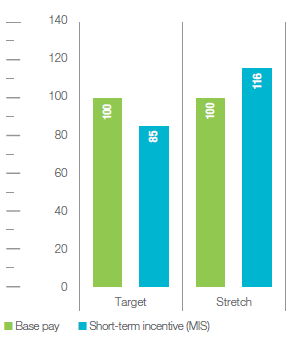
The chart below illustrate the total potential remuneration (base pay and short-term incentives) for executive directors at different performance levels.
Performance Share Plans (PSPs) are excluded from these scenarios as their vesting depends on performance conditions being met. Vesting is based on a linear vesting schedule over a four-year period.
Statement of fair and responsible remuneration
The group's compensation policy for the remuneration of executive directors and other senior executives is set taking appropriate account of remuneration and employment conditions of other employees in the group.
The committee annually receives a report from management on pay practices across the group, including salary levels and trends, collective bargaining outcomes and bonus participation. At the time that salary increases are considered, also the committee receives a report on the approach management proposes to adopt for general staff increases. Both these reports are taken into account in the committee's decisions about the remuneration of executive directors and other senior executives.
In some countries where the group operates, more formal consultation arrangements with employee representatives are in place relating to employment terms and conditions, in accordance with local legislation and practice. The group also conducts employee engagement surveys every two years which gauge employees' satisfaction with their working conditions. The Sappi board is given feedback on these survey results.
Approach to remuneration benchmarks
Executive compensation is benchmarked on data provided in national executive compensation surveys, for countries in which executives are domiciled, as well as information disclosed in the annual reports of listed companies of the JSE. Sappi participates in global remuneration surveys and uses data from global remuneration surveys ie PwC, Mercer, et al to determine appropriate remuneration levels.
Ensuring an appropriate peer group to retain the integrity and appropriateness of the benchmark data is a key task of the Human Resources and Compensation Committee. Executive pay is benchmarked every alternate year.
The remuneration package for a newly appointed executive director would be set in accordance with the terms of the group's approved remuneration policy in force at the time of appointment. The variable remuneration for a new executive director would be determined in the same way as for existing executive directors. For internal and external appointments, the group may meet certain relocation expenses, as appropriate.
Remuneration policy for non-executive directors (fees)
| Element | Purpose | How it works? | Fees | |||
| Non-executive Chairman (fees) |
|
|
|
|||
| Other non-executive directors (fees) |
|
|
|
Sappi may reimburse the reasonable expenses of board directors that relate to their duties on behalf of Sappi. Sappi may also provide advice and assistance with board directors' tax returns where these are impacted by the duties they undertake on behalf of Sappi.
All non-executive directors have letters of appointment with Sappi Limited for an initial period of three years. In accordance with best practice, non-executive directors are subject to re-election at the AGM after the three-year period. Appointments may be terminated by Sappi with six months' notice. No compensation is payable on termination, other than accrued fees and expenses.
Voting on remuneration
As required by King IV, Sappi's remuneration policy and implementation report need to be tabled for separate non-binding advisory votes by shareholders at the upcoming AGM. In the event that either the remuneration policy or the implementation report, or both, are voted against by 25% or more of the voting rights entitled to be exercised by shareholders at such AGM, then the committee will ensure that the following measures are taken in good faith and with best reasonable efforts:
- An engagement process to ascertain the reasons for the dissenting votes
- Appropriately addressing legitimate and reasonable objections and concerns raised which may include amending the remuneration policy or clarifying or adjusting remuneration governance and/or processes.
You can also view the full remuneration policy on www.sappi.com
Section C: Remuneration implementation report
Compensation structure
Total compensation comprises fixed pay (ie base salary and benefits) and variable performance-related pay, which is divided further into short-term incentives with a one-year performance period and long-term incentives which have a four-year performance period.
Compensation mix
The compensation mix for executive directors and executive committee members is shown in the schematics below and alongside.
The long-term incentive awards are based on the face value of the performance plan shares issued in December 2019 (share price at date of allocation: ZAR80.60 November 2018). Details of the executive directors' remuneration can be found below.
| Executive directors (number of employees at September 2019 = 2) (%) | Executive Committee (number of employees
at 30 September 2019 = 7) (%) |
||
 |
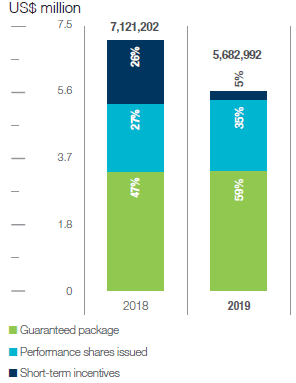 |
Our compensation policy aims to have a balance between base salary, short and long-term incentives. No short-term bonuses were paid in 2019 to the majority of executive committee members.
Base salary
The Compensation Committee approved the level of base salary for each executive director, executive committee member and other key senior managers.
Increases are effective from 01 January each year. There are no automatic annual base salary adjustments.
The 2019 salary increases were based on individuals' performances and contributions, internal relativities, inflation rates in the countries of operation, general market salary movement and overall affordability.
The same salary increase percentages were applied in determining the salaries for executive directors and executive committee members' increases as was the mandate for general staff, dependent on location.
For 2019 Mr Binnie received a salary increase of 5% on the South African portion of his salary and 1.5% on the offshore portion. His salary with effect from 01 January 2019 was US$539,629 per annum.
Mr Pearce received a salary increase of 5% on the South African portion of his salary and 1.5% on the offshore portion. Mr Pearce's salary with effect from 01 January 2019 was US$312,014 per annum.
For the Executive Committee, two members were awarded a short-term bonus.
Retirement benefits
Retirement benefits are largely in the form of defined contribution schemes. In some instances, legacy defined benefit schemes exist. Almost all the defined benefit schemes are closed to new hires.
Mr Binnie and Mr Pearce are both members of defined contribution funds and the total employee and company contribution is ZAR350,000 each.
No additional payments were made to any retirement fund on behalf of the executive directors.
Short-term incentive
Performance-related annual bonuses may be paid to executive directors and other executive and senior managers under the Management Incentive Scheme. The scheme is designed to incentivise the achievement of pre-defined annual financial targets and personal objectives which are critical measures of business success.
For the 2019 financial year, the financial business performance criteria were: EBITDA (50%), working capital (20%) and safety (10%) – which accounted for 80% of the bonus calculation, with the remaining 20% being based on individual performance during the year.
The bonus payment opportunity available to executive directors and executive committee members is as follows:
| On-target bonus | Stretch target | ||||
| Executive director | 85% of base salary | 116% of base salary | |||
| Regional chief executive officer | 70% of base salary | 95% of base salary | |||
| Other prescribed officers (ie Executive Committee members) | 65% of base salary | 88.5% of base salary |
A performance threshold of 85% of budgeted EBITDA for the group is required before any bonus can be paid to participants in the group scheme.
Furthermore, if a region does not achieve the 85% bonus threshold target, no bonus is paid to participants in the region irrespective of overall group performance. Only Sappi Southern African will be entitled to a bonus payment for fiscal 2019. They have met the 85% threshold on EBITDA.
The group's performance for the 2019 financial year:
| Performance criteria | Points | 2019 actual achievement | |||
| EBITDA* | 50 | 0 | |||
| Working capital** | 20 | 0 | |||
| Safety*** | 10 | 0 | |||
| Total | 80 | 0 |
| * | Budgeted EBITDA as less than the 85% threshold, hence zero. |
| ** | Working capital needs to be at least 110% of target, 2019 was above at 112%, hence zero. |
| *** | The group and regional safety performance improved, zero was allocated to the Executive Committee and applicable regions due to the tragic fatalities. |
Personal objectives of executives for 2019 Management Incentive Scheme
Key objectives and achievements
The executives share many key objectives and have individual objectives specific to their role, some examples are as follows:
|
Rationalising declining business |
|
During 2018 Sappi continued to balance paper supply and demand. Capacity was reduced by conversions, carouselling opportunities. The graphic paper manufacturing capacity reduced by approximately 550,000 tons since 2014. Converting paper machines to higher-margin businesses with the implementation of transformation programmes in Europe and North America. In total, 11 mills are now converted in the group to produce speciality and/or packaging paper. |
|
Maintain healthy balance sheet |
 |
The focus was on strong cash generation, sale of non-core assets and debt reduction. The improved balance sheet enabled the investment in further pulp integration with the acquisition of the Matane Mill from Rayonier. |
|
Accelerate growth in higher margin growth segments |
|
Expanding the packaging grades is an ongoing process. The Cham operations have been successfully integrated in the Sappi Europe business. The specialised cellulose portfolio is also being enhanced by expansion at Ngodwana (completed), Saiccor (in progress) and Cloquet (completed). The lignosulphonate business was expanded, but, commercialising biotech products are more challenging than expected. |
|
Achieve cost advantages |
|
The optimisation of the business process continues to gain momentum with the establishment of global business centres and the Global Business Council. IT centres of excellence were established, HR was unified into nine global processes and a brand council was created to focus on global marketing efforts. Through our cost-saving initiatives, pulp buying and the global freight programme, Sappi's savings for 2019 exceeded US$80 million. Energy and efficiency investments were made at several of the operations. |
|
Sustainability |
|
Developed the Sappi sustainability strategy. See more details on Sappi's sustainability performance in our key material issues of the Annual Integrated Report. |
|
Talent and succession |
|
During this period, a new CEO for Sappi North America (SNA) was appointed from the SNA team. This is proof of the good succession planning process in place. CEO and Chairman of the board followed a rigorous process to appoint three new non-executive directors. |
|
Sappi Southern Africa's (SSA) performance relative to the Employment Equity Act and new Forestry Charter |
|
Sappi Southern Africa retained a level 2 rating after the independent Empowerdex audit in 2019 and 2018. |
2019 Management Incentive Scheme outcomes for executives
| % | EBITDA | Working capital | Safety | Personal | Total | |
|---|---|---|---|---|---|---|
| Weight | 50 | 20 | 10 | 20 | 100 | |
| Steve Binnie | – | – | – | 20 | – | |
| Glen Pearce | – | – | – | 18 | – |
Based on 2019 performance against the set targets as defined by the board in October 2018, neither Mr Binnie or Pearce will not qualify for a bonus payment in 2019.
The terms and conditions of the annual incentive scheme for executive directors and executive committee members affords the company the right to seek redress and recoup from an individual where for any reason the board determines, within a 12-month period of such payment, that the performance goals (whether for the participant or for the group) were in fact not achieved following the restatement of financial results or otherwise.
Long-term incentive
The Sappi Performance Share Plan (PSP) provides for annual awards of conditional performance shares which are subject to meeting performance targets measured over a four-year period. These awards will only vest if Sappi's performance, relative to a peer group of 16 other industry-related companies, is ranked at median or above the median.
The performance criteria are relative total shareholder return (TSR) and relative cash flow return on net assets (CFRONA).
The peer group for the 2019 PSP award consisted of:
- Fortress Paper
- Lenzing
- Rayonier Advance Materials
- Ahlstrom-Munksjo
- Borrogaard
- Domtar
- West Rock
- Sun Paper
- UPM-Kymmene
- Holmen
- Metsá Board
- Verso
- Mondi plc
- International Paper
- Stora Enso
- Resolute Forest Products.
Performance Share Plan
As disclosed in previous reports, the committee approved the linear vesting schedule for 2015 allocations which will be applicable from the 2019 vesting and onwards. This will have the impact that, at median performance, 25% of the allocation vests. The vesting schedule for 2015 allocation for both TSR and CFRONA is as follows:
| Position | Vesting % | |
| 1 – 5 | 100 | |
| 6 | 80 | |
| 7 | 65 | |
| 8 | 45 | |
| 9 | 25 | |
| 10 – 17 | – |
For the four-year period ended September 2019, Sappi's performance relative to the peer group measured on TSR was ranked sixth, which meant that 80% TSR component shares vested on the due date in December 2019.
The determination of the vesting of the shares was provided by Mercer Kepler, an independent third party.
Sappi's performance relative to the peer group measured on CFRONA for the same period resulted in 100% of this portion of the awards vesting, as Sappi's performance was ranked in third place. The determination of the vesting of this portion of the shares was verified by KPMG.
In aggregate, therefore 90% of the total 2015 awards vested.
In December 2015, Mr Binnie was granted 190,000 conditional performance plan shares of which 171,000 will vest in December 2019.
In December 2015, Mr Pearce was granted 90,000 conditional performance plan shares of which 81,000 will vest in December 2019.
The historical vesting of PSP awards:
| Share awards | 2015
% |
2016
% |
2017 % |
2018
% |
2019
% |
|||
|---|---|---|---|---|---|---|---|---|
| TSR | – | 100 | 100 | 100 | 80 | |||
| CFRONA | 100 | 100 | 100 | 100 | 100 | |||
| Aggregate | 50 | 100 | 100 | 100 | 90 |
Vesting since 2016 which had been at 100% on both performance criteria, reduced to 90% for 2019. However, the markets we operate in are expected to remain challenging in the coming year, and profitability is likely to be negatively impacted as a result. DWP pricing, in particular, will have a significant impact on earnings as this segment is a major contributor to our profits and cash flow generation.
Performance Share Plan allocations for 2019
Each year, Mercer Kepler provides management with a recommendation for an appropriate pool size. For the 2019 allocation, it was approved to grant the number of shares implied by the same ZAR value of prior-year PSP awards, where value is based on trailing long-run average share price at grant (eg 12 months). This approach has been applied for the last three years and is consistent with recommendations by our shareholders, to disclose the allocation method. This meant the pool size was adjusted by some 10% (6% based on share price movement and 4% based on an average salary adjustment across all regions).
Mr Binnie was awarded 156,000 conditional performance plan shares in December 2019 that will vest in December 2023.
Mr Pearce was awarded 71,000 conditional performance plan shares in December 2019 that will vest in December 2023.
Changes to the long-term incentive scheme
Sappi received authority to use 7.95% of shares for the Sappi Limited Share Incentive Trust (the scheme) and/or the Sappi Limited Performance Share Incentive Trust (the plan) from shareholders at the AGM on 07 March 2005. This was equivalent to 19 million shares subject to adjustment in case of any increase or reduction of Sappi's issued share capital on any conversion, redemptions, consolidations, sub-division and/or any rights or capitalisation issues of shares.
After the rights issue undertaken by Sappi in November 2008, this number increased to 42.7 million (still equivalent to 7.95% of the shares in issue at the time). Since obtaining shareholder approval in 2005, Sappi has been allocating shares to participants and currently has only 5.8 million shares available to issue and is therefore close to the shareholder-approved limit. The authority to use the shares in the plan and the scheme has been in place for 14 years and with an annual burn rate of just under 1%.
Sappi has prepared the requisite ordinary resolutions to be tabled at the AGM in February 2020, requesting shareholders to (i) approve an additional 27.8 million shares, being approximately 5% of Sappi's issued shares as at September 2019, that can be used to incentivise management under the rules of the plan in years ahead and (ii) to place these shares under the specific control of directors to issue in terms of the rules of the plan. Approval will be sought from shareholders to reset the numbers of shares under the plan only as Sappi is liquidating the scheme. This reset will happen with effect from date of approval of the resolution and all future outstanding shares will be calculated accordingly.
Employee Share Ownership Plan (broad-based black economic empowerment)
The Employee Share Ownership Plan (Sefate) was established in 2009 to meet the requirements of broad-based black economic empowerment established in the Forestry Sector Charter and in line with the codes set out by the South African Department of Trade and Industry.
There are two schemes which make up Sappi's Employee Share Ownership Plan, namely the Employee Share Ownership Plan (ESOP) and Management Share Ownership Plan (MSOP). There were 5,607 participants in the schemes at the end of September 2014. Eligible employees receive an allocation based on seniority, of A ordinary shares and ordinary shares. Shares vest 40% after three years and 10% each year thereafter.
Shares may, however, only be taken up after September 2019. Employees receive the net value in shares or cash at the end of the lock-in period.
In terms of the rules of the scheme, the A units for both schemes lapsed as the threshold of ZAR73.50 was not achieved. The B units delivered value for the participants. The board approved an ex gratia payment, in lieu of all the units that lapsed under the scheme of approximately US$1 million. This was distributed to current permanent Sappi employees. Value to each participant was determined based on the number of A units they hold. The scheme has come to an end. Management, together with the board, are working on alternatives to replace the Sefate scheme. Sappi will, however, retain its ownership points under the Forestry Charters for the next nine years.
Dilution
If all outstanding option and plan shares were to be exercised or vest as at September 2019, the resulting dilution effect would be 2.26% (2018: 2.42%) of issued ordinary share capital excluding treasury shares. To the extent possible, treasury shares will continue to be used to meet future requirements for shares arising from the exercise of options and vesting of awards.
Share ownership guidelines and restrictions
The Chief Executive Officer, Mr Binnie, volunteered to hold a target number of shares equal to 2 x his annual base salary by December 2020. He currently holds shares to the value of approximately 134% of his annual base salary. The lower share price has impacted the short-term value of his holding, however, he is committed to achieving this target as soon as possible. There is no requirement for the Chief Financial Officer and the executive committee members to hold a specific number of shares during their employment with the company.
Remuneration disclosure of executive directors and prescribed officers
Executive directors' emoluments for 2019 (US$)
| US$ | Salary | Performance- related remuneration |
Sums paid by way of expense allowance |
Contributions paid under pension and medical aid schemes |
Share- based payment benefit |
Total | |
|---|---|---|---|---|---|---|---|
| SR Binnie1 | 539,629 | – | 14,819 | 82,317 | 635,321 | 1,272,086 | |
| GT Pearce2 | 312,014 | – | 8,422 | 60,185 | 301,641 | 682,263 |
| 1 | SR Binnie received a 5% increase on the South African portion (72% of total salary), and a 1.5% increase on the offshore portion (28% of total salary). Overall salary expressed in reporting currency was 3.3% lower than in 2018. |
| 2 | GT Pearce received a 5% increase on the South African portion (73% of total salary), and a 1.5% increase on the offshore portion (27% of total salary). Overall salary expressed in reporting currency was 3.4% lower than in 2018. |
- Base salary – the actual salary earned during 2019
- Retirement benefits – the annual contribution paid by the company into a defined benefit fund on behalf of the members determined as a percentage of their base salary
- Other payments – expense allowances
- Annual cash bonus – the actual bonus earned in 2019 based on the rules of the Management Incentive Scheme
- Long-term incentive – conditional performance plan shares awarded in 2019 financial year which will vest in 2023 if the TSR and CFRONA targets are met
- Local earnings are translated into the reporting currency (US Dollar) using the average exchange rate over the financial year. The average rate for the South African Rand depreciated by 10%, and for the Swiss Franc 2.2%
- Due to the earnings currencies (ZAR) depreciating against the reporting currency (US$) over the year, this had the effect of showing earnings in US Dollar terms to be lower than last year.
Executive directors' emoluments for 2018 (US$)
| US$ | Salary | Performance- related remuneration | Sums paid by way of expense allowance |
Contributions paid under pension and medical aid schemes | Share-
based payment benefit |
Total | |
| SR Binnie | 558,318 | 525,830 | 14,907 | 85,129 | 701,472 | 1,885,656 | |
| GT Pearce | 322,878 | 303,971 | 8,473 | 63,461 | 292,857 | 991,640 |
Prescribed officers/executive committee members
Prescribed officers are members of the Group Executive Committee.
The table below sets out the remuneration for prescribed officers for 2019:
| US$ | Salary | Bonuses and performance- related payments |
Sums paid by way of expense allowance |
Contributions paid under pension and medical aid scheme |
Share-based payment benefit |
Total | |
|---|---|---|---|---|---|---|---|
| B Wiersum | 756,218 | – | 2,820 | 258,045 | 360,596 | 1,377,679 | |
| M Gardner(1) | 564,133 | – | – | 57,222 | 360,596 | 981,951 | |
| A Thiel | 325,447 | 189,876 | 9,379 | 57,939 | 360,596 | 943,237 | |
| M van Hoven | 167,871 | – | 4,964 | 43,939 | 282,976 | 499,750 | |
| G Bowles | 253,087 | – | 7,865 | 106,199 | 301,641 | 668,792 | |
| F Marupen | 182,354 | – | 5,219 | 47,238 | 235,658 | 470,469 | |
| M Mansoor | 276,886 | 106,828 | 157,904 | 105,498 | 111,072 | 758,188 |
The table below sets out the remuneration for prescribed officers for 2018:
| US$ | Salary | Bonuses and performance- related payments |
Sums paid by way of expense allowance |
Contributions paid under pension and medical aid schemes |
Share- based payment benefit |
Total | |
| B Wiersum | 779,507 | 511,203 | 2,976 | 261,304 | 353,023 | 1,908,013 | |
| M Gardner | 548,690 | 442,734 | – | 56,125 | 353,023 | 1,400,572 | |
| A Thiel | 336,541 | 230,261 | 9,435 | 61,199 | 384,436 | 1,021,872 | |
| A Rossi(2) | 84,049 | 43,391 | 2,460 | – | – | 129,900 | |
| M van Hoven | 173,061 | 123,824 | 4,994 | 47,087 | 279,116 | 628,082 | |
| G Bowles | 250,935 | 183,597 | 7,534 | 104,581 | 297,682 | 844,329 | |
| F Marupen | 188,705 | 134,788 | 5,250 | 50,189 | 196,818 | 575,750 | |
| M Mansoor(3) | 205,370 | 152,653 | 115,083 | 73,390 | 66,188 | 612,684 |
| (1) | Retired in September 2019. |
| (2) | Retired in December 2017. |
| (3) | Appointed in January 2018. |
Non-executive directors' fees
Directors are normally remunerated in the currency of the country in which they live or work from. Their remuneration is translated into US Dollar, the group's reporting currency, at the average exchange rate prevailing during the financial year. Directors' fees are established in local currencies to reflect market conditions in those countries.
Non-executive directors' fees reflect their services as directors and services on various sub-committees on which they serve. The quantum of committee fees depends on whether the director is an ordinary member or a chairman of the committee. Non-executive directors do not earn attendance fees, however, additional fees are paid for attendance at board meetings more than the five scheduled meetings per annum.
The Chairman of the Sappi Limited board receives a flat director's fee and does not earn committee fees. Non-executive directors do not participate in any incentive schemes or plans of any kind.
In determining the fees for non-executive directors, due consideration is given to the fee practice of companies of similar size and complexity in the countries in which they are based. The extreme volatility of currencies, in particular the ZAR/US Dollar exchange rate in recent years, caused distortions of the relative fees in US Dollar paid to individual directors. Every second year, Mercer provides a recommendation on fees to the committee.
Non-executive directors' fees are proposed by the Executive Committee, agreed by the Compensation Committee, recommended by the board and approved at the AGM by the shareholders.
The non-executive directors' fees for 2019 financial year were approved by shareholders. The table below sets out the remuneration for non-executive directors for 2019:
| 2019 | |||||
| US$ | Board fees | Committee fees |
Travel allowance |
Total | |
|---|---|---|---|---|---|
| KR Osar | 69,320 | 35,050 | 18,500 | 122,870 | |
| JD McKenzie | 44,944 | 19,518 | 7,400 | 71,862 | |
| ANR Rudd | 402,325 | – | 11,100 | 413,425 | |
| NP Mageza | 30,037 | 40,950 | 7,400 | 78,387 | |
| MV Moosa | 30,037 | 28,512 | 7,400 | 65,949 | |
| MA Fallon | 58,687 | 65,376 | 11,100 | 135,163 | |
| RJAM Renders | 69,238 | 64,601 | 11,100 | 144,939 | |
| B Mehlomakulu | 30,037 | 9,759 | 7,400 | 47,196 | |
| Z Malinga1 | 30,037 | 15,596 | 7,400 | 53,033 | |
| BR Beamish2 | 34,235 | 8,271 | – | 42,506 | |
| JM Lopez2 | 40,419 | 4,175 | 7,400 | 51,994 | |
| JE Stipp3 | 23,097 | 5,842 | 3,700 | 32,639 | |
| Total | 862,413 | 297,650 | 99,900 | 1,259,963 | |
| 1 | Appointed to the board in October 2018. |
| 2 | Appointed to the board in March 2019. |
| 3 | Appointed to the board in June 2019. |
| 2018 | |||||
| US$ | Board fees | Committee fees |
Travel allowance |
Total | |
| D Konar(1) | 13,686 | 14,344 | – | 28,030 | |
| KR Osar | 74,140 | 34,100 | 18,000 | 126,240 | |
| JD McKenzie | 50,394 | 20,511 | 7,200 | 78,105 | |
| ANR Rudd | 419,684 | – | 10,800 | 430,484 | |
| NP Mageza | 34,729 | 37,569 | 7,200 | 79,498 | |
| R Thummer(2) | 24,700 | 7,478 | 7,000 | 39,178 | |
| MV Moosa | 34,729 | 24,834 | 7,200 | 66,763 | |
| MA Fallon | 66,335 | 67,223 | 10,800 | 144,358 | |
| RJ De Koch(3) | 65,806 | 21,357 | 14,400 | 101,563 | |
| RJAM Renders | 78,937 | 67,022 | 10,800 | 156,759 | |
| B Mehlomakulu | 31,565 | 10,255 | 7,200 | 49,020 | |
| Total | 894,705 | 304,693 | 100,600 | 1,299,998 | |
| (1) | Retired from the board in January 2018. |
| (2) | Retired from the board in December 2017. |
| (3) | Retired from the board in August 2018. |
Statement by the board regarding compliance with the remuneration policy
The board annually receives a report from the Human Resources and Compensation Committee on pay practices across the group, including salary levels and trends, collective bargaining outcomes and bonus participation.
The board endorses the Human Resources and Compensation Committee position that Sappi's remuneration policy is set taking appropriate account of remuneration and employment conditions of other employees in the group and external factors. It is the view of the board that this policy, as detailed herein, drives business performance and value creation for all stakeholders.
 Annual Integrated Report