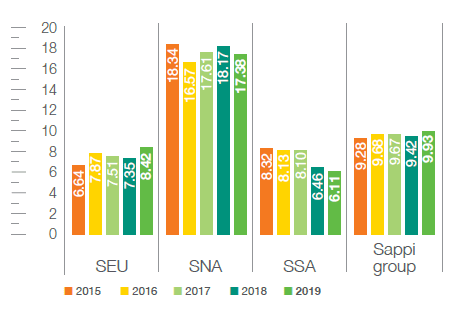
| Total water withdrawal by source (m3/adt) |
 |
Comment:
Globally, the trend for total water withdrawal was stable.
It decreased in SEU, while in SNA total surface water
withdrawal decreased at Cloquet Mill and was stable at
Somerset Mill. Withdrawal in SSA was stable.
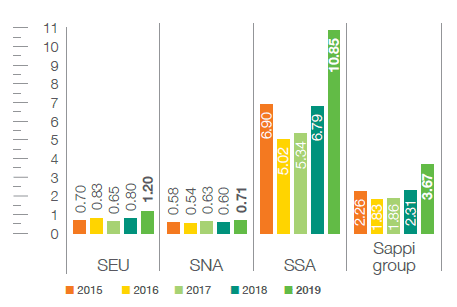
| Specific water returned to extracted (m3/adt) |
 |
Comment:
Globally, consumption was stable. There was an
increase in water consumption in SEU, due mainly
to the rebuild of PM9, PM8 and PM6 at Gratkorn,
Lanaken and Maastricht Mills respectively. Water
consumption was higher year-on-year at Stockstadt
Mill because of 15% higher pulp production. The
decrease in specific water consumption in SNA was
due to increased production at Cloquet and Somerset
Mills, combined with decreased total use. Decreased
water consumption in SSA was due to initiatives at
all mills:
- Saiccor Mill: Reduced specific consumption due to an increase in production and a number of water-savings initiatives including repairing leaks, reducing tank overflows and an improvement in condensate recovery
- Ngodwana Mill: Improved efficiencies because of increased production rates
- Stanger Mill: Sugar mill off-crop shut (the mill uses sugar cane waste residue – bagasse), process water was replaced with recovered water in the pulp mill, process optimisations, improved water use in the bagasse depithing plant.
- Tugela Mill: Improved water balance controls on the paper machine to reduce unnecessary makeup; improved stability on paper machine and spray dryer; further water reduction especially on PM2 with cleaning processes and reduced overflowing of backwater tank; increased stability on the digester; reduced make-up water by stopping waste plant when PM2 was not operating.
CASE STUDY
Reducing water use at Stanger Mill
In reviewing ways to reduce water use, the mill focused on the significant water users in the mill—the pulp and wet depithing operations. We have replaced processed freshwater with recovered water at the screw feeder and rock cyclone in the pulp mill. This was followed by optimisations on the pith clarifier and belt washer. The pulp mill water use reduced from an average volume of 6.8 m3/min in 2018 to 6.1 m3/min in 2019.