


Our key material issues – People
People
Issues discussed here are covered in greater detail in the  People section.
| Material issue |
Why it’s important | What we did about it in 2019 | How it
links to risk |
How it links to other aspects of our business | ||||||||||||
| Safety | Unsafe practices and conditions can have devastating consequences—the impact of human loss and suffering on individuals and those around them is immeasurable. Globally, the pulp and paper industry, and forestry in particular, is viewed as potentially hazardous. |
Our safety performance was deeply unsatisfactory:
Lost-time injury frequency rate (group) 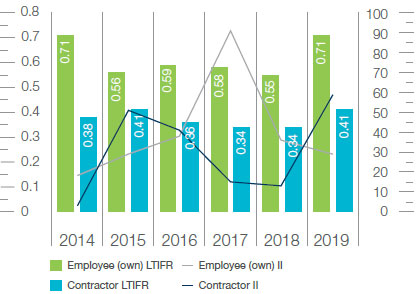 |
#1 Safety Integration of sustainability |
|
||||||||||||
| Employee engagement | When employees are engaged at work, they feel a connection with the company. They believe that the work they're doing is important and therefore work harder. This has obvious implications for productivity, career development and job satisfaction. |
|
#9 Employee relations Integration of sustainability |
|
||||||||||||
| Skills | People are no longer looking for a 'job for life' but have moved toward 'learn for life'. At the same time, rapid changes in the operating environment are constantly reshaping the skills requirements of our business. |
|
#9 Employee relations #10 Failure to attract and retain key skills |
Operating context –
|
||||||||||||
| Labour relations | Sound labour relations result in increased levels of engagement, enhanced productivity and a more harmonious working environment. | Sappi endorses the principles of fair labour practice as entrenched in the United Nations Global Compact and the Universal Declaration of Human Rights. At a minimum, we conform to and often exceed labour legislation requirements in countries in which we operate. We promote freedom of association and engage extensively with representative trade unions. Globally, approximately 62% of Sappi's workforce is unionised, with 69% belonging to a bargaining unit. Sappi enjoyed relatively positive industrial relations with trade unions at all manufacturing sites across the group and Sappi Forests' plantations in SSA—attributable mainly to our proactive engagement strategy and initiatives. |
#9 Employee relations Social unrest Integration of |
Operating context –
|
||||||||||||
| Shared value | Shared value involves developing profitable business strategies that deliver tangible social benefits. In other words, identifying societal challenges within our sphere of operation and finding ways of addressing these for the mutual benefit of communities and the company, thereby enhancing our social licence to operate, building our reputation as a responsible corporate citizen, establishing customer loyalty and attracting talent. | We continued to take a very active approach to corporate shared value (CSV) both regionally and globally, driving key initiatives in support of our three primary stakeholder groups—employees, customers and the local communities in which we operate. Given South Africa's development needs, in line with our long-standing approach, the bulk of spend was allocated to this region as follows:
|
Integration of sustainability Social unrest Land restitution |
Operating context –
|
 Risk



CASE STUDY
Investing in early childhood development
International research states that 90% of brain growth and development takes place before the age of five. Research also indicates that children whose development is nurtured early in life are more likely to be:
- Successful in school, have fewer learning disabilities and be more likely to finish high school and seek further education or training
- More productive in the workforce, hold better jobs, own their own homes, and
- Healthier throughout their lives, physically and mentally.
Against this backdrop, the South African government prioritised early childhood development (ECD) as highlighted in the National Development Plan (NDP) Vision for 2030.
We began investing in ECD in 2014, partnering with key role players to achieve the following results:
- In Mpumalanga, we have developed an ECD centre of excellence at the Sappi Elandshoek community through Penreach, the largest teacher development programme in Africa. Sappi has sponsored the training of the principal and five primary school teachers from a local primary school in ECD-related topics. Between 2016 and 2018, these teachers reached 415 children.
- In 2016, we extended the ECD programme to Gauteng, by sponsoring the Jabulani Training and Development Centre. Our sponsorship of the centre has contributed to training over 1,250 ECD practitioners in recent years.
- In 2018, 22 ECD practitioners graduated from the ECD programme in KZN with an NQF4 qualification (a national standard), implemented under the auspices of Training and Resources in Early Education (TREE), and a further 36 will complete their training at the end of 2019. Of these, 18 will have a NQF4 certification which they will administer in their créches, while the other 18 have been trained to run playgroups in their areas, where previously no ECD facilities existed. Practitioners in this region have impacted 2,097 children between 2016 and 2018.
